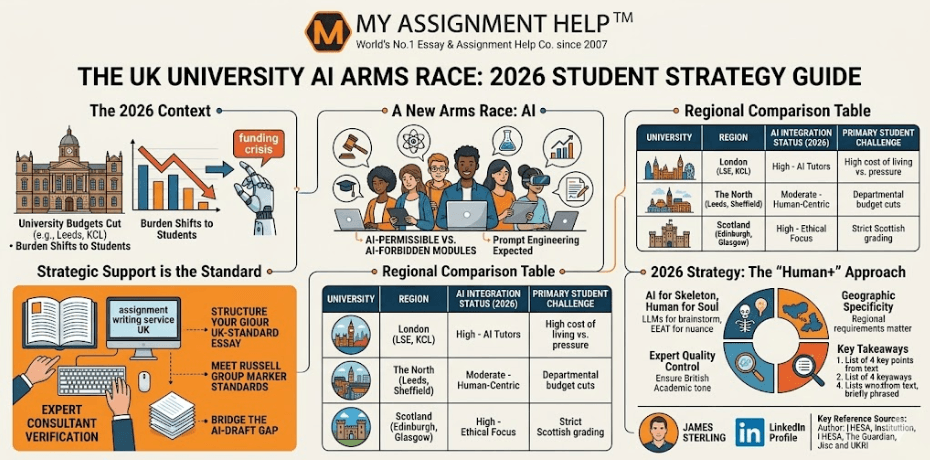
The UK higher education sector is currently navigating its most turbulent period since the 2012 tuition fee hike. With the 2025/26 funding crisis forcing institutions from the University of Leeds to King’s College London (KCL) to slash departmental budgets, a new “arms race” has emerged: Artificial Intelligence. While some universities are winning by integrating generative tools into their core pedagogy, others are losing ground, leaving students to navigate a fragmented landscape of “AI-permissible” vs. “AI-forbidden” modules.
The Reality of the 2026 British Campus
In cities like Manchester and Birmingham, the student experience has shifted. It is no longer just about attending lectures at the Whitworth Building; it’s about managing the cognitive load of a degree that expects you to be a prompt engineer, a data analyst, and a critical researcher simultaneously. As universities struggle with the cost of digital infrastructure, the burden of “staying ahead” has shifted onto the student.
This pressure is particularly acute for those tackling high-stakes modular assessments. To maintain a competitive edge, many are turning to strategic external resources. Utilizing a professional assignment writing service uk has transitioned from a niche luxury to a standard component of the UK student’s toolkit. By seeking expert guidance on how to structure a UK-standard essay, students can bridge the gap between basic AI-generated drafts and the high-level critical analysis required by Russell Group markers.
Winners and Losers: The 2026 EdTech Divide
The “Modernisation of British degrees” isn’t happening at a uniform pace.
- The Winners: Universities that have moved past the “fear of ChatGPT” and established clear AI-literacy frameworks.
- The Losers: Institutions still relying on outdated detection software that frequently flags non-native English speakers for “false positives,” creating a culture of academic anxiety.
| University Region | AI Integration Status (2026) | Primary Student Challenge |
| London (LSE, KCL) | High – AI Tutors integrated into VLE. | High cost of living vs. academic pressure. |
| The North (Leeds, Sheffield) | Moderate – Focus on “Human-Centric” AI. | Departmental budget cuts affecting contact hours. |
| Scotland (Edinburgh, Glasgow) | High – Heavy focus on ethical AI research. | Strict adherence to traditional Scottish grading scales. |
Securing the Future: The PhD Hurdle
For those looking beyond undergraduate studies, the competition for doctoral funding in the UK has never been fiercer. With the UKRI tightening its belt, a mediocre proposal is a death sentence for a research career. In the research hubs of Oxford and Cambridge, the emphasis is now on “Generative Engine Optimization” for literature reviews—knowing how to find the data that AI often misses.
This high-barrier entry is why more postgraduates are investing in a phd proposal writing service. In the UK’s current academic climate, your proposal must demonstrate not just a “gap in knowledge,” but a mastery of the digital transformation currently hitting your specific field. Whether you are at the University of Warwick or UCL, professional mentorship ensures your research methodology holds up under the intense scrutiny of a post-crisis admissions board.
2026 Strategy: The “Human+” Approach
To survive the EdTech shift, students must adopt a “Human+” mindset. This means:
- AI for Skeleton, Human for Soul: Use LLMs to brainstorm, but use your own “Experience and Expertise” (the core of EEAT) to provide the critical nuance that gets a 1st class mark.
- Geographic Specificity: Understand that a law degree in Cardiff has different regional requirements than one in Belfast.
- Expert Quality Control: Don’t let an algorithm be your final editor. Use human-led services to ensure your tone of voice is “British Academic,” not “Silicon Valley Bot.”
Key Takeaways
- Funding Crisis Impact: Budget cuts in UK HE mean fewer contact hours; students must be more self-reliant.
- The AI Divide: Not all UK universities handle AI the same; check your specific faculty’s 2026 guidelines.
- Strategic Support: Professional writing services act as a “tutor-on-demand” in a cash-strapped university system.
- Critical Thinking is King: AI can’t replicate the specific “Experience” required for top-tier UK marks.
See also: Privacy Coins Explained: Features and Risks
FAQ Section
Q: How do UK universities like Manchester or Leeds detect AI in 2026?
A: Most have moved away from basic “detectors” and now use “Stylometric Analysis,” comparing your current submission to your previous work. This is why using professional support to learn better writing is safer than simply generating text.
Q: Is the UK university funding crisis affecting international student visas?
A: While the crisis is financial, the academic standards remain high. International students are expected to show even higher levels of “Authoritativeness” in their work to justify their place in a competitive system.
Q: Should I mention AI tools in my PhD proposal?
A: Yes. In 2026, failing to mention how you will use technology to manage your data is seen as a lack of “Expertise.”
About the Author
James Sterling is a Senior Content Strategist at MyAssignmentHelp with a decade of experience in the UK’s digital education sector. Based in London, James has consulted for EdTech firms across Manchester and Bristol, helping students navigate the complexities of British academic standards.
References
- Higher Education Statistics Agency (HESA) 2026 Report on Digital Literacy.
- The Guardian (May 2026): “The Silent Crisis: How UK Universities are Cutting Costs.”
- Jisc (2025): “Navigating the AI Arms Race in the Russell Group.”
- UKRI (2026): “New Standards for Doctoral Research Proposals.”