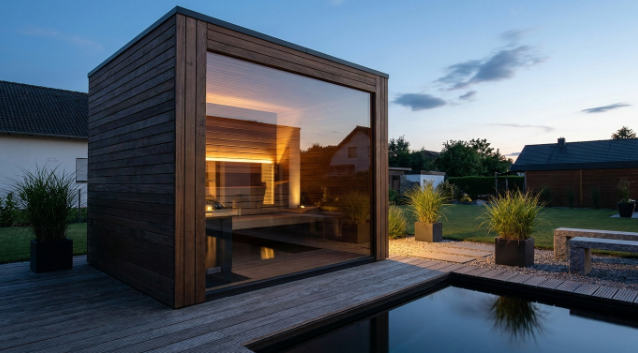
The five most common mistakes when buying a cube sauna are undersizing the heater relative to the amount of glass, skipping the permit and electrical planning until after delivery, placing it on an unlevel or poorly drained base, underestimating how little the compact footprint actually saves once utilities are added, and choosing a glass style based on looks alone without weighing heat loss. Each one is avoidable with about an hour of planning before you order, and each one is expensive or annoying to fix after the unit is sitting in your yard.
Mistake One: Undersizing the Heater for the Glass
Cube saunas are defined by their glass, often a full door and sometimes an entire wall of panoramic window, and that glass loses heat noticeably faster than a solid cedar wall. Buyers who size a heater strictly off the interior cubic footage, using a generic one-kilowatt-per-fifty-cubic-feet rule meant for a standard cabin, frequently end up with a unit that runs constantly but never quite holds the target temperature on cold nights. The fix is straightforward: bump the heater one size class above what the volume alone would suggest whenever the design includes more than a standard door’s worth of glass, and confirm the manufacturer’s own wattage recommendation for that specific glass configuration rather than a generic chart.
Mistake Two: Treating Electrical Work as an Afterthought
A cube sauna heater in the 6 to 8 kW range needs a dedicated 240-volt circuit, and running that circuit from the panel to a freestanding backyard structure is often the single biggest line item in the whole project, sometimes $500 to $1,500 depending on distance and whether the run is trenched underground. Buyers who order the sauna first and call an electrician after delivery frequently discover the panel doesn’t have capacity, or that trenching under a patio or driveway will cost far more than expected, well after the return window on the unit itself has closed. Getting a electrician’s estimate before ordering, not after, avoids a sauna sitting unused in the yard for weeks or months.
Mistake Three: Putting It on an Unlevel or Poorly Drained Base
A cube’s flat floor and often flat or nearly flat roof make it less forgiving of an uneven foundation than a rounded barrel design, since even a small lean can throw off how the glass door seals and how water sheds off the roof. Grass, bare dirt, or a hastily leveled gravel patch all tend to shift with frost heave and rain over a season, which shows up later as a door that no longer closes flush or water pooling against one wall. A concrete pad, a properly compacted paver base, or a pressure-treated deck frame built to spec solves this, and it’s far cheaper to get right before delivery than to jack up and relevel a fully assembled cube afterward.
Mistake Four: Assuming Compact Means Cheap
The cube’s small footprint is genuinely useful for tight yards, but buyers sometimes assume that a smaller structure automatically means a smaller total budget, then get surprised when the electrical trenching, the foundation pad, and delivery access all cost roughly the same regardless of whether the cabin is 4×4 or 6×8. A realistic budget for a cube sauna install adds $1,000 to $3,000 in site work and electrical on top of the unit price itself, and that range doesn’t shrink much just because the structure is compact. Pricing the whole project, not just the cabin, before comparing models avoids sticker shock partway through.
Mistake Five: Choosing Glass Style on Looks Alone
A full panoramic glass wall photographs beautifully and is a major reason cube saunas have become popular, but it comes with real tradeoffs: more heat loss, a higher recommended heater size, and in some cases less privacy depending on how the yard is oriented toward neighbors or the street. Buyers who pick the biggest glass option purely because it looks best in a listing photo sometimes find themselves adjusting the heater, adding a privacy screen, or wishing they’d chosen a standard door with a smaller adjacent window instead. Weighing glass area against your specific yard’s privacy, sun exposure, and wind before ordering, rather than after installation, is the cheapest time to make that call. Shoppers comparing glass configurations and matching heater specs side by side across models can check current cube listings at sweatdecks.com before deciding.
A Sixth Problem Worth Naming: Delivery Access
Cube saunas typically arrive as a heavy, pre-assembled or near-fully-assembled unit rather than flat-packed parts, which means the delivery truck and any crane or forklift used to place it need a clear path to the final site. Buyers who order a cube for a backyard reachable only through a narrow side gate or over a fence sometimes discover on delivery day that the unit simply can’t get where it’s supposed to go without disassembly the manufacturer doesn’t support, or an expensive crane lift over the house. Measuring gate widths, checking overhead clearance for power lines, and confirming with the seller how the specific model ships, whether it’s one solid piece or a few large panels, before ordering saves a stressful and sometimes costly delivery day.
What Do These Five Mistakes Have in Common?
None of them are about picking the wrong brand. They’re all planning problems: an electrician not consulted early, a foundation not built to spec, a budget that ignored site work, and a glass choice made without weighing the tradeoffs. A buyer who treats the site and electrical planning with the same seriousness as picking the cabin itself ends up with a cube sauna that gets used year-round instead of one that becomes a source of ongoing annoyance.
Frequently Asked Questions
What is the most common mistake people make buying a cube sauna?
Undersizing the heater for the amount of glass in the design, since a large glass door or window wall loses heat faster than solid cedar walls.
Do cube saunas need a permit?
It depends on your municipality, footprint, and height. Many places exempt small accessory structures from a full building permit, but electrical work usually needs its own permit.
Can a cube sauna sit directly on grass or dirt?
No. It needs a level, well-drained base such as a concrete pad or deck frame, since an unlevel foundation can warp the floor and affect the door seal.
Is a cube sauna hard to move once installed?
Most are heavier and less modular than barrel saunas, so relocating one after electrical hookup and foundation work is a significant job.
References
- “Benefits and risks of sauna bathing.” The American Journal of Medicine, 2001. https://pubmed.ncbi.nlm.nih.gov/11165553/
- “Clinical Effects of Regular Dry Sauna Bathing: A Systematic Review.” Evidence-Based Complementary and Alternative Medicine, 2018. https://pubmed.ncbi.nlm.nih.gov/29849692/
- “Cardiovascular and Other Health Benefits of Sauna Bathing: A Review of the Evidence.” Mayo Clinic Proceedings, 2018. https://pubmed.ncbi.nlm.nih.gov/30077204/
- National Fire Protection Association. https://www.nfpa.org/
By Dale Whitcombe